The silence cloaking the Pentagon has shattered once again. In a move that has sent shockwaves through the geopolitical landscape, President Donald Trump has ordered the public release of a highly anticipated second tranche of classified government files. This massive data dump, published directly on a Department of War repository, unearths over 170 deeply unsettling accounts of Unidentified Anomalous Phenomena. Consequently, the disclosure bridges generations of secrecy, stretching from the dawn of the Cold War to terrifyingly recent military engagements.
Researchers and civilian analysts are scrambling to dissect the declassified paperwork. Specifically, the collection contains frantic teletype messages, internal NASA memos, and modern infrared sensor data. These documents do not offer comfort. Instead, they present a cold, clinical ledger of encounters with objects that defy our current understanding of physics. The information suggests that our skies have been systematically compromised by an unknown, highly advanced intelligence for decades.
The Savannah River Saucer and the FBI Pivot
Among the historical anomalies, a chilling teletype message dated August 9, 1952, exposes deep anxiety within critical American infrastructure. Two employees at the strategic DuPont Chemical plant in Savannah River, South Carolina, witnessed something impossible. The workers observed a brilliant blue light with an orange fringe shaped distinctly like a saucer. According to the document, the craft flew at a high rate of speed, traveling in a northeastern direction over the secure facility.
Because the incident targeted a nuclear-adjacent facility, the message flew directly to FBI Director J. Edgar Hoover. However, Hoover shifted the responsibility quickly. Two days later, Hoover responded with a calculated, bureaucratic retreat. He stated that the United States Air Force was actively investigating flying saucers. Therefore, he forwarded the file to the Director of Special Investigations. This historic correspondence reveals that early government agencies recognized the threat but actively sought to avoid public accountability.
Dissolving Mists and the Philadelphia Incident
Historical files reveal that encounters with these anomalies often took place in densely populated civilian areas. Specifically, on September 27, 1950, two patrolling officers with the Philadelphia Police Department encountered a descending object. The craft measured roughly six feet in diameter and settled quietly into a nearby open field.
The responding officers noted that the object gave off a strange, purplish glow that resembled a thick mist. Seeking assistance, they summoned two additional officers to the dark field. After watching the glowing mass for some time, the men attempted to physically retrieve it. Consequently, the object broke apart, leaving a slight, completely odorless residue. Within twenty-five minutes of its descent, the entire physical structure completely disintegrated into nothingness, leaving the officers in absolute disbelief.
The Gemini 7 Orbit Enigma
The chilling reality of these phenomena extends far beyond our atmosphere. Included in Trump's recent disclosure are explosive original transcripts from NASA's historic Gemini 7 mission on December 4, 1965. Astronauts Frank Borman and Jim Lovell had just achieved orbit when they encountered something unexpected. Borman radioed Mission Control in Houston to report a mysterious tracking presence.
Borman: "We have a bogey at 10:00 o'clock high."
Houston: "This is Houston. Say again, Seven."
Borman: "I said we have a bogey at 10:00 o'clock high. We also have very many, it looks like hundreds of little particles going by to the left."
The newly released files include a handwritten note from a panicked NASA official confirming the incident as a true unidentified object. To preserve public calm, officials carefully managed the press fallout. The full transcripts are now preserved within the National Archives, verifying that early space pioneers faced anomalous encounters while orbiting Earth.
Modern Military Infrared Captures and Mid-East Encounters
While historical files provide crucial context, the most terrifying elements of the release involve recent military encounters. The document dump contains startling infrared sensor logs from active combat zones. Specifically, an encounter on January 1, 2020, over the Middle East features heavily in the reports. A military pilot captured a brilliant, dancing point of light moving erratically across his targeting screen. The anomalous object lingered for over a minute before vanishing instantly.
Exactly four years later, on New Year's Day 2024, military sensors captured an even more complex craft. Operating in the same region, an aircraft tracked a massive, football-shaped body. The object featured three distinct, fin-like projections extending from its metallic hull. One fin pointed vertically, while two angled downward at matching forty-five-degree angles. This bizarre craft hovered in total defiance of aerodynamic principles for nine seconds before blinking out of existence.
January 1, 2020: A bright, dancing point of light maneuvers erratically over the Middle East for 63 seconds.
New Year's Day 2024: A football-shaped craft with three geometric fins hovers before vanishing from infrared sensors.
2013 Naval Encounter: An eight-pointed, star-like body swerves before a Navy jet, leaving a fine contrail.
Advanced Propulsion and the Physics of the Unknown
The data reveals a consistent pattern of technology that outpaces human capabilities. For example, the 2013 naval encounter describes an eight-pointed, star-like body swerving directly in front of an advanced Navy fighter jet. The craft left a fine contrail of exhaust, indicating a highly exotic propulsion mechanism. This incident mirrors earlier encounters where objects defied extreme atmospheric winds without using visible wings or traditional rotors.
These accounts challenge our fundamental understanding of aviation technology. Witnesses consistently describe crafts that can accelerate instantly from a dead hover to supersonic speeds. Furthermore, these objects perform sharp, right-angle turns that would instantly crush a human pilot under intense gravitational forces. The Department of War has confirmed that more files will be released on a rolling basis.
Breaking the Silence on Global Anomalies
This second wave of declassified material confirms that the global phenomenon is real, persistent, and entirely unexplained. The government can no longer dismiss these reports as mere weather balloons or atmospheric illusions. Trained military observers, sophisticated radar systems, and infrared targeting sensors have documented the exact same anomalies across multiple decades.
As the public processes this information, the true origin of these crafts remains a mystery. President Trump’s rolling disclosure policy suggests that additional, more disturbing files remain hidden in deep government archives. Humanity must now confront a profound reality. We share our airspace with an intelligence that operates with complete impunity, leaving us to watch the skies with growing dread.
Navigating the New Era of Disclosure
The sudden flood of official data has completely changed the landscape of modern ufology. Historically, researchers relied on leaked, blurry photographs and anonymous whistleblowers to build their cases. Today, the Department of War is providing raw, unedited military data directly to the public. Consequently, the burden of proof has shifted from proving the existence of these anomalies to identifying their origin.
Scientists are now examining these cases to understand the propulsion systems used by these craft. The capability to hover silently in extreme winds suggests control over localized gravity fields. If civilian scientists can unlock the secrets hidden in these military reports, it could revolutionize human transportation. However, the true intent of these visitors remains the most critical, unanswered question facing our world today.
What Lies Ahead in the Archives
The promise of rolling disclosures means that this current release is just the beginning of a larger revelation. Rumors are already circulating about upcoming drops containing deep-sea sonar logs and underwater anomalies. Many researchers believe the next set of files will focus on transmedium craft that move seamlessly between outer space, the atmosphere, and our oceans.
To review historical milestones in space exploration and early atmospheric tracking, readers can explore the NASA Archives. These historical databases provide the baseline data needed to analyze the newly released military intelligence. Until the next file drop occurs, the world waits in suspense, watching the skies for the next inevitable encounter.
The Shadow War for Disclosure: Inside Trump's PURSUE Initiative and the Gatekeepers Defending the UFO Core Secret
A deep silence usually follows the exposure of a decades-old lie. On May 8, 2026, the White House shattered that silence. The Executive Branch bypassed decades of resistance from the intelligence community. It launched the Presidential Unsealing and Reporting System for UAP Encounters (PURSUE). Millions of citizens rushed to look at the newly live government servers.
UFO researchers have warned about this for generations. They knew the government would never hand over the truth willingly. Now, we are witnessing a massive institutional civil war. On one side, the presidency demands complete transparency. On the other side, an unelected intelligence network fights to keep eighty years of secrets buried.
These new documents are not the blurry photos of the early internet. They are raw and deeply unsettling records. The first wave of official disclosure has arrived. These files cover everything from the moon's surface to sensitive military zones. They bring a chilling realization: we are not alone.
Inside the PURSUE Files: The May 2026 Release
The government recently released 162 highly classified files. This historic dump includes files from the FBI, NASA, and the Department of Defense. This release represents the first phase of a rolling declassification plan. The digital archives contain 120 PDF dossiers, 28 military videos, and 14 high-resolution images. These files detail incidents that authorities could not resolve.
PURSUE Initial Declassification Statistics (May 8, 2026)
-------------------------------------------------------
Total Files Released:  162
PDF Dossiers:          120
Raw Military Video:    28
High-Res Image Files:  14
Total Redacted Files:  108
Primary Agencies:      DoD, FBI, NASA, State Department
Strange Objects in the NASA Archives
The new files contain extraordinary photos from historical space programs. For example, the public can now access an amazing photograph from the Apollo 17 mission. You can find it within the digital NASA archives.
The photo shows three glowing objects arranged in a tight triangle against the black lunar sky. Official logs classify the image as an "Unresolved UAP Report." The text admits the objects defy all known astronomical explanations.
The "Eye of Sauron" Incident
Another file details a terrifying 2023 encounter. Federal employees spotted a massive, hovering orb over a domestic military base. Eyewitnesses said the craft looked like the "Eye of Sauron." It was a glowing sphere with a dark center.
The object actively scanned the ground below. The craft easily evaded all radar tracking. It then shot vertically out of the atmosphere at over Mach 20 without making a sonic boom.
The documents also feature a 2024 report from the U.S. Indo-Pacific Command. Naval pilots intercepted a football-shaped object near Japan. The craft was the size of a commercial airliner. However, it had no wings, no exhaust plumes, and no visible engines. Radar logs show the object dropped from 60,000 feet to the ocean surface in less than a second. Terrestrial materials would shatter under such extreme speed.
Who Is Blocking UFO Disclosure?
While the public reads these files, a dangerous conflict is playing out in Washington. The government now admits these objects exist. Now, the big question is different. Who has been hiding the master files?
A deeply embedded network inside the intelligence community acts as the main roadblock. Private defense contractors also help them. This group uses strict classification rules to hide secrets from Congress.
The Failure of AARO and the Pentagon
The All-Domain Anomaly Resolution Office (AARO) is a prime target for critics. Congress created AARO to bring transparency. Instead, the office has gone completely quiet. AARO failed to deliver its required annual reports. It also withheld the second volume of its historical review.
The Architecture of UAP Concealment
   [Executive Directive] ---> Orders Immediate Release
                                   |
         +-------------------------+-------------------------+
         |                                                   |
         v                                                   v
[Department of War / PURSUE]                       [The Gatekeeper Network]
Status: Deploying Tranches                        Status: Active Resistance
Action: 162 Files Unsealed                        Action: Withholding Video Logs
                                                          AARO Reports Delayed
                                                          108/162 Files Redacted
Congress Clashes with Defense Leaders
Congressional investigators are fighting back. Representative Anna Paulina Luna is leading the charge against defense leaders. In March, investigators demanded the immediate release of unedited UFO videos.
Whistleblowers have confirmed these videos exist. One specific video shows a spherical UFO moving through the clouds. The Pentagon ignored the deadline. This proves that a rogue network still operates within the government.
The Black-Budget Arms Race
Why do these groups maintain the cover-up? It is not just to prevent public panic. A highly classified, global arms race drives the secrecy. Private aerospace companies have tried to reverse-engineer recovered UFO technology for decades.
Inside these black-budget programs, the rule is simple: you cannot tell your friends without telling your enemies. Admitting the technology exists would expose domestic progress to foreign rivals. Therefore, they choose absolute silence.
Global UFO Sightings: The Monthly Roundup
The UFO crisis is not just happening in America. The newly released files include many State Department cables. These documents show that embassies worldwide have quietly tracked strange activity for decades. Diplomatic messages from 1985 through late 2025 detail incidents in places like Georgia, Mexico, and Kazakhstan.
The December 2025 US Incursion: Military tracking systems caught a massive, dark silhouette over a training range. The object ignored the wind. It flew sideways at hypersonic speeds before vanishing from thermal cameras.
The Kuwait Contrast Anomaly (May 2022): A combat report details an elongated object over a military zone. Sensor logs showed the object's energy increasing rapidly. Yet, it gave off no detectable heat signature.
The Baltic Sea Transients (March 2026): Classified sonar logs show multiple metallic objects moving along the seabed. They traveled at speeds over 80 knots. These objects easily outperformed modern submarines.
These international accounts show a coordinated presence in our skies. The objects operate freely across national borders. The sheer volume of these cables proves that foreign governments are just as terrified as the US.
What Is Coming Next in June 2026?
The files released so far are just the beginning of a massive shift. The White House confirmed that the May release was the first step. The next major wave of United States UFO files will drop in June 2026. Rumors suggest this next batch contains unredacted files about crash retrievals. It may include physical and biological data that scientists have never seen.
Rolling Disclosure Timeline (2026)
----------------------------------
[February 2026] ----- Presidential Executive Directive Issued
[May 8, 2026]   ----- Launch of PURSUE / First Tranche (162 Files)
[Mid-May 2026]  ----- Congressional Standoff Over Unredacted Videos
[June 2026]     ----- Scheduled Second Tranche (Material Recoveries)
The Battle Over Redacted Data
However, the shadow network is fighting back with heavy bureaucracy. Out of the 162 files in the first wave, 108 contained blacked-out sections. Entire pages of radar data and sensor types remain hidden. The administration claims they did not hide the actual encounters. Even so, the gatekeepers are hiding how the military tracks these objects.
As the June deadline nears, the cultural impact is growing. High-ranking politicians expect the upcoming videos to challenge traditional beliefs. Some lawmakers even compare these flying spheres to "biblically accurate" angels. The wall of secrecy has cracked. The truth is no longer a guess. It is a rising tide, and the gatekeepers cannot stop it.
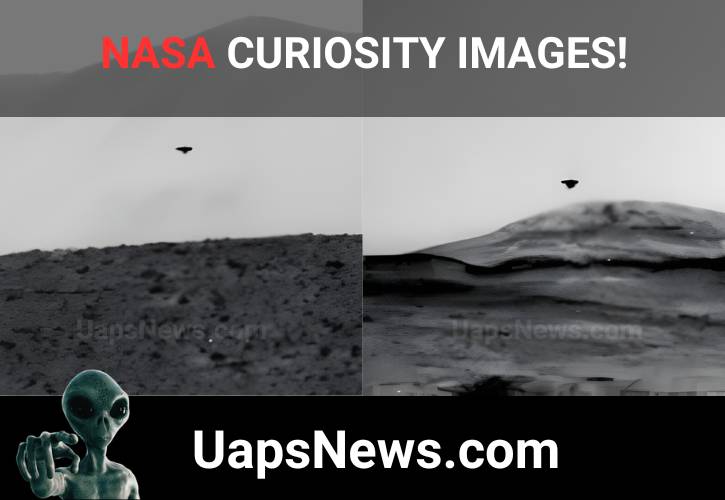
The Red Planet has always been a focal point for those searching for signs of life beyond Earth. While NASA’s rovers, Curiosity and Perseverance are tasked with geological surveys and hunting for microbial fossils, their raw image feeds occasionally capture something that defies conventional explanation.
At UAPS News, our team has been scouring the archives, and we have uncovered two extraordinary images that demand a closer look. Despite being taken years apart, they appear to show a strikingly similar "saucer-type" craft hovering in the Martian sky.
The Evidence: UAPS Sightings, One Mystery
The first image comes from the early years of the Curiosity mission, while the second is a much more recent capture.
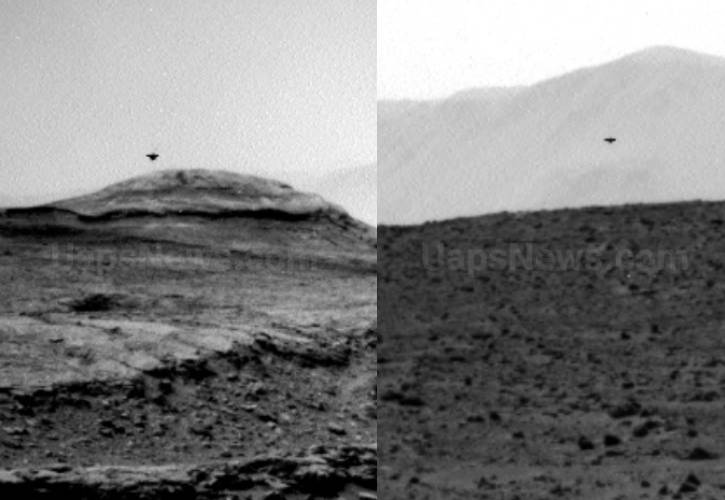
1. The Initial Sighting (Sol 669) In this raw frame captured by Curiosity’s Right Navigation Camera (Navcam), a distinct, dark object is visible against the horizon.
2. The Recent Enigma (Sol 4110) Fast forward thousands of Martian days (Sols), and a nearly identical shape appears again, seemingly maintaining a presence in the thin Martian atmosphere.
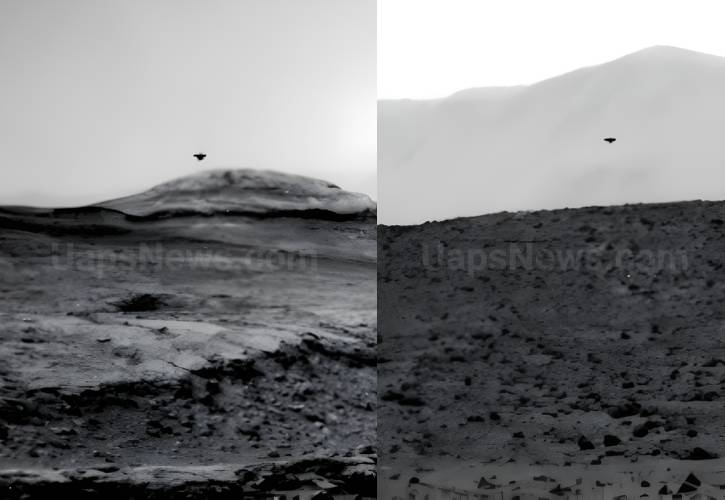
To get a better understanding of what we are looking at, the UAPS News team has performed digital enhancements on these raw frames. By adjusting contrast levels and reducing the "noise" inherent in long-distance space photography, the silhouettes become much sharper.
The results are startling. Rather than looking like a random "hot pixel" or a speck of dust on the lens, the enhancements reveal a structured, disc-like shape. The object possesses the classic "saucer" profile—thick in the center and tapering toward the edges—a hallmark of many UAP sightings reported on Earth.
Hovering or Following Curiosity?
What makes these two images particularly haunting is the consistency. Between the first sighting and the second, years have passed. Yet, the craft's morphology remains unchanged.
This leads to a chilling hypothesis: Is it possible that NASA’s Curiosity rover is being monitored? The objects do not appear to be moving at high speed; rather, they seem to be "station-keeping"—hovering at a specific altitude as if observing the rover’s progress across the Gale Crater.
The "Same Craft" Theory
While skeptics might point toward "Martian birds" (highly unlikely in a near-vacuum) or cosmic ray hits on the camera sensor, the similarity between the two captures is difficult to ignore. The fact that the same geometric shape appears in the sky across different years suggests a persistent presence.
Is this a single craft that has been shadowing our technology for over a decade? Or is there a fleet of these saucer-type UAPs operating within the Martian atmosphere?
As NASA continues to explore the surface, we will continue to look at the skies. The data is there, hidden in plain sight within the official archives. It just takes a closer look to see that we might not be the only ones exploring Mars. Apart?
Mainstream physics says what UFOs do is impossible. French physicistJean-Pierre Petit says it’s only impossible if you ignore half the universe. Dive into the controversial "Janus Model" and the mind-bending concept of negative mass that could unlock the stars.
For decades, the phenomenon we now call UAPs (Unidentified Anomalous Phenomena) has taunted humanity. We see objects accelerating at impossible g-forces, making instantaneous right-angle turns, plunging from space into the ocean without a splash, and vanishing from radar instantly.
According to the physics taught in universities today, these things are impossible. The energy required would be astronomical; the g-forces would turn any biological pilot into soup. Therefore, skeptics argue, they cannot exist.
But what if the problem isn’t our eyes, our radar, or the pilots testifying to these realities? What if the problem is our physics?
Enter Jean-Pierre Petit, a brilliant, maverick French astrophysicist and former director of research at the CNRS (National Center for Scientific Research). For 40 years, Petit has argued that our current cosmological model is fundamentally broken. He proposes a radical alternative, a theory that doesn't just explain the anomalies of the universe—it provides a veritable blueprint for interstellar travel.
It’s called the Janus Cosmological Model, and at its heart lies a concept that makes most scientists uncomfortable: Negative Energy.
The Broken Puzzle of the Standard Cosmos
To understand why Petit’s ideas are so revolutionary, we first need to understand what’s wrong with the current picture.
When astronomers look at the universe, things don’t add up. Galaxies spin so fast they should fly apart. The universe is expanding faster and faster every day. To explain this using Einstein's current theories, scientists had to invent two mysterious, invisible substances:
Dark Matter: Invisible "stuff" added to galaxies to provide extra gravity to hold them together.
Dark Energy: A mysterious force pushing space apart, causing accelerating expansion.
Together, these make up about 95% of the universe. Yet, after decades of searching, we have never found a single particle of either. They are mathematical "fudge factors" kept to make the current theories work.
Jean-Pierre Petit says: Stop looking. They don’t exist.
The Janus Universe: The Two-Sided Coin
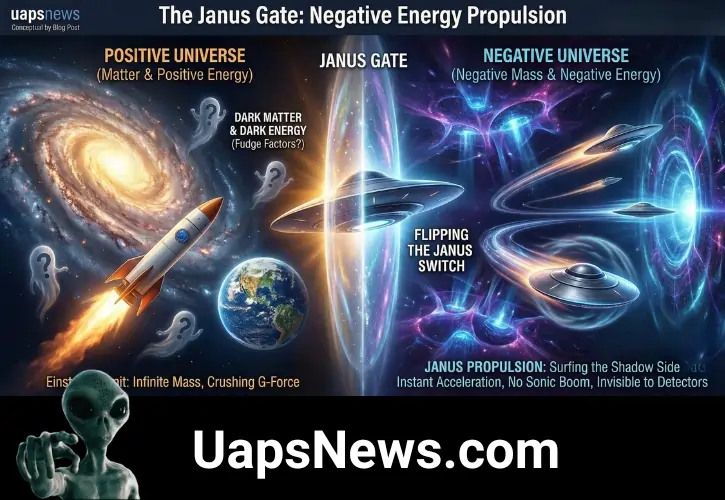
Petit’s Janus Model (named after the two-faced Roman god) proposes something elegant yet unsettling. He suggests we don’t live in a single universe. We live in a bi-metric universe—a cosmos with two "sheets" or two sides occupying the same space-time.
Side A (Our Side): This is the world of positive mass, ordinary matter, and positive energy. It's everything we can see and touch.
Side B (The Shadow Side): This is a twin universe dominated by negative mass and negative energy.
This is where you need to stretch your mind. Negative mass isn't antimatter (antimatter actually has positive mass). Negative mass is something else entirely.
Imagine holding a ball. It has positive mass; gravity pulls it down. A ball of negative mass would weigh less than nothing. If you pushed it forward, it would accelerate backward.
In Petit's Janus model, these two universes interact through gravity, but with a twist:
Positive mass attracts positive mass (normal gravity).
Negative mass repels other negative mass.
Crucially, positive mass and negative mass repel each other.
This simple set of rules solves the biggest cosmic mysteries without needing "dark" substances. The universe is expanding because the vast sea of negative mass in the shadow universe is pushing our positive matter galaxies apart. Galaxies hold together because they are hemmed in by the repelling force of surrounding negative mass.
But for readers of uapsnews, the real excitement isn't in cosmology. It’s in propulsion.
Surfing the Shadow: How Advanced Civilizations Move
If an advanced civilization understands that the universe has two sides, they wouldn't be limited to burning chemical rockets or slowly pushing against the fabric of our positive space-time. They would learn to access the "shadow side."
The incredible movements of UAPs—the instant acceleration, the lack of sonic booms—are signature traits of craft utilizing negative energy propulsion.
Here is how an advanced intelligence could exploit the Janus universe to do the "impossible":
1. Smashing the Cosmic Speed Limit
In our positive universe, as you approach the speed of light, your mass increases infinitely, requiring infinite energy to go faster. It's a cosmic brick wall.
But the negative universe operates under different metric rules. The speed of light is vastly higher there. By creating a field that allows their craft to interact with, or partially shift into, the negative energy framework, an alien craft isn't breaking the laws of physics—it’s just changing jurisdictions.
They could effectively "surf" on the repelling force between positive and negative mass. They aren't being pushed by an engine; they are being repelled by space itself. This allows for velocities that would seem instantaneous to us, without the crushing g-forces associated with normal acceleration.
2. The Ultimate Cloaking Device
Why are UAPs so hard to track? Why do they disappear from radar or sight instantly?
Petit’s model offers a chillingly simple explanation. We see things because photons (light particles) bounce off them and hit our retinas or sensors. Our instruments are designed to detect positive energy photons.
Matter in the negative universe emits negative energy photons.
If an advanced craft shifts its energetic signature towards the negative, it becomes, for all intents and purposes, a ghost. It is still physically there, but the light it emits or reflects passes right through our detectors. It becomes invisible to our reality while still navigating it. When pilots see a tic-tac "vanish," it hasn't necessarily warped away; it may have just "flipped the Janus switch," slipping into the shadow realm just beneath the surface of our perception.
The Challenge to Think Deeper
Jean-Pierre Petit’s ideas have been largely ignored or ridiculed by mainstream academia, often because they require abandoning cherished theories like Dark Matter. But as the UAP phenomenon forces disclosure and admits that something is flying in our skies using technology we cannot fathom, the Janus Model deserves a second look.
It forces us to ask a difficult question: Are we alone in the universe because the distances are too great? Or does the universe seem empty only because we are looking at only half of the picture, blind to the negative energy ocean that advanced life uses as its highway?
If Petit is right, the "impossible" engines we see in the sky aren't magic. They are just physics we haven't accepted yet.
If you have looked at the night sky recently and wondered if we are alone, you are not the only one. A strange object is speeding through our solar system right now, and it has astronomers, data scientists, and even government agencies scratching their heads. It is called 3I/ATLAS, and depending on who you ask, it is either a very weird rock, a cluster of icy debris, or—if you are willing to entertain the more radical theories—a piece of technology from another star.
Since its discovery in July 2025, this object has refused to behave like a normal comet. It does not look right. It does not move right. And just when scientists thought they had a handle on it, new data from December 2025 threw everyone for a loop. We are seeing rhythmic pulses of light, "anti-tails" pointing the wrong way, and speeds that defy the gravitational grip of the Sun.
Here is a deep look at what is happening with 3I/ATLAS, stripping away the tabloid panic to look at the raw data and the fascinating possibilities.
The Stranger from Deep Space
First, we need to establish why 3I/ATLAS matters. Most comets and asteroids we see are locals. They were born here, formed from the same dust and gas that built Earth, Mars, and Jupiter. They orbit the Sun in predictable loops.
3I/ATLAS is different. It is an "interstellar object." The "I" in its name stands for Interstellar. It is only the third one we have ever caught passing through our neighborhood. The first was ‘Oumuamua in 2017, a cigar-shaped oddity that tumbled through space. The second was Borisov in 2019, which looked much more like a standard comet.
Then came 3I/ATLAS. It dropped into our system from the void between stars, moving at a blistering 58 kilometers per second—too fast to be captured by the Sun’s gravity. It is just passing through. It swooped past the Sun in late October 2025 and is now on its way out, heading back into the blackness of deep space. But on its way out, it is putting on a show that no one expected.
The "Heartbeat" Anomaly
The most recent and baffling update involves a rhythmic pulse. As of early December 2025, observers noticed that 3I/ATLAS is not just glowing steadily; it is flickering. Every 16.16 hours, its brightness shifts dramatically.
Harvard astrophysicist Avi Loeb has been vocal about this. He suggests that this regular pulse is hard to explain with simple rotation. If it were just an oddly shaped rock spinning around, the light curve should look different. Instead, Loeb proposes a "heartbeat" mechanism—periodic bursts of gas or activity.
Imagine a sprinkler system that turns on and off with precise timing. Loeb argues that if this were a natural icy body, the heating from the Sun should cause a more chaotic release of steam and dust. A clockwork cycle of 16 hours suggests something specific is driving it. For the naturalists, this might be a single, large patch of volatile ice exposed to the Sun with every rotation. For those leaning toward the artificial hypothesis, it looks suspiciously controlled.
The "Anti-Tail" and the Swarm
Comets usually have tails that point away from the Sun, pushed by solar wind. 3I/ATLAS has that, but it also has something else: a sunward-pointing spike called an "anti-tail."
While anti-tails can sometimes be optical illusions caused by the angle of observation, the geometry here is tricky. Recent images from the Hubble Space Telescope and the European Space Agency’s JUICE mission (which got a great look at the object while on its way to Jupiter) show a structure that is hard to dismiss as a trick of the light.
Some data suggests 3I/ATLAS might not be a single solid rock at all. It could be a "swarm"—a cluster of smaller objects moving together. This would explain why the object seems to accelerate in ways gravity cannot explain. If it is shedding mass, or if it is a loose collection of debris, the solar pressure would push it differently than a solid boulder.
Loeb has taken this a step further, suggesting that if it is a swarm, it might be artificial debris or probes. He points out that the "swarm" maintains a very specific formation, lagging slightly closer to the Sun than a natural dust cloud should.
Cryovolcanoes: The Ice Volcano Theory
Before we jump to aliens, we have to look at the leading natural theory: cryovolcanism. This is the idea that 3I/ATLAS is essentially a giant, flying slushie machine that is exploding.
Astronomers from the Spanish Institute of Space Sciences recently proposed that the object is covered in ice volcanoes. Unlike Earth volcanoes that spew lava, these erupt with cold gases like carbon monoxide and nitrogen. As the object got close to the Sun in October, the intense heat cooked these volatile ices, causing violent, rhythmic eruptions.
This theory fits a lot of the data. It explains the "heartbeat" (periodic eruptions as the vent spins into sunlight). It explains the weird acceleration (the jets of gas act like thrusters, pushing the comet off course). It even explains the "anti-tail" as a trail of heavier icy chunks blasted out by these explosions.
If this is true, 3I/ATLAS is a pristine relic from another solar system, freezing a chemical sample of a distant star's birth and delivering it to our doorstep. That alone is a massive scientific win.
The Panic: Space Defenses and Drills
You might have seen headlines claiming that world governments are "activating space defenses" because of 3I/ATLAS. This is where things get muddy.
Here is the reality: The International Asteroid Warning Network (IAWN) and other agencies did run exercises recently. These were drills designed to test how quickly we could track a fast-moving, unpredictable object. 3I/ATLAS provided the perfect live-fire test subject. It is fast, it is weird, and it is right there.
So, yes, NASA and the ESA pointed their sensors at it. Yes, they ran communication drills. But this does not mean they think it is an attack. It means they are using a rare opportunity to calibrate their instruments. The "panic" is largely social media noise. The object is not on a collision course with Earth. It will pass us safely, millions of kilometers away.
What Comes Next?
We are currently in the golden hour for observing 3I/ATLAS. It is moving away from us, but it is still bright enough for our most powerful telescopes.
The JUICE spacecraft is sending back data that will take months to fully analyze. The Hubble images from late November are being scrutinized pixel by pixel. In mid-December, it will reach its closest point to Earth, giving us one last good look before it fades into the dark.
The debate over its nature—rock, swarm, or machine—will likely rage on for years. ‘Oumuamua is still debated today, eight years after it left. 3I/ATLAS is providing even more data, which paradoxically leads to more questions.
Whether it is a natural cryovolcanic wonder or something more exotic, 3I/ATLAS is a reminder that the space between stars is not empty. It is full of traffic, and occasionally, something pulls over to say hi.