
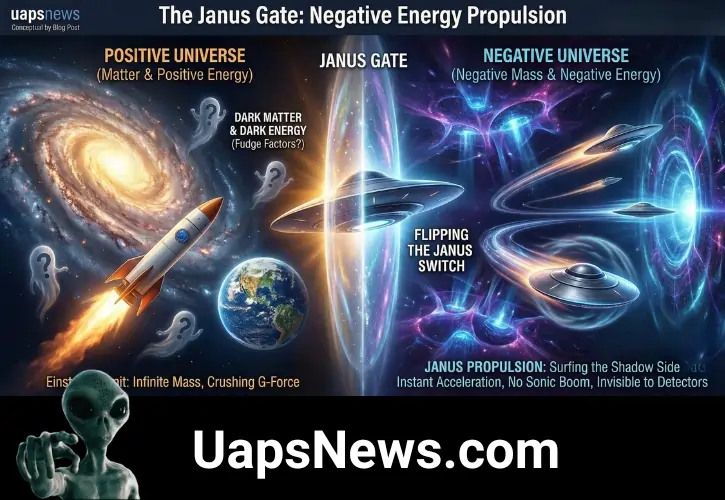
Mainstream physics says what UFOs do is impossible. French physicist Jean-Pierre Petit says it’s only impossible if you ignore half the universe. Dive into the controversial "Janus Model" and the mind-bending concept of negative mass that could unlock the stars.
For decades, the phenomenon we now call UAPs (Unidentified Anomalous Phenomena) has taunted humanity. We see objects accelerating at impossible g-forces, making instantaneous right-angle turns, plunging from space into the ocean without a splash, and vanishing from radar instantly.

According to the physics taught in universities today, these things are impossible. The energy required would be astronomical; the g-forces would turn any biological pilot into soup. Therefore, skeptics argue, they cannot exist.
But what if the problem isn’t our eyes, our radar, or the pilots testifying to these realities? What if the problem is our physics?
Enter Jean-Pierre Petit, a brilliant, maverick French astrophysicist and former director of research at the CNRS (National Center for Scientific Research). For 40 years, Petit has argued that our current cosmological model is fundamentally broken. He proposes a radical alternative, a theory that doesn't just explain the anomalies of the universe—it provides a veritable blueprint for interstellar travel.
It’s called the Janus Cosmological Model, and at its heart lies a concept that makes most scientists uncomfortable: Negative Energy.
The Broken Puzzle of the Standard Cosmos
To understand why Petit’s ideas are so revolutionary, we first need to understand what’s wrong with the current picture.
When astronomers look at the universe, things don’t add up. Galaxies spin so fast they should fly apart. The universe is expanding faster and faster every day. To explain this using Einstein's current theories, scientists had to invent two mysterious, invisible substances:
- Dark Matter: Invisible "stuff" added to galaxies to provide extra gravity to hold them together.
- Dark Energy: A mysterious force pushing space apart, causing accelerating expansion.
Together, these make up about 95% of the universe. Yet, after decades of searching, we have never found a single particle of either. They are mathematical "fudge factors" kept to make the current theories work.
Jean-Pierre Petit says: Stop looking. They don’t exist.
The Janus Universe: The Two-Sided Coin
Petit’s Janus Model (named after the two-faced Roman god) proposes something elegant yet unsettling. He suggests we don’t live in a single universe. We live in a bi-metric universe—a cosmos with two "sheets" or two sides occupying the same space-time.
- Side A (Our Side): This is the world of positive mass, ordinary matter, and positive energy. It's everything we can see and touch.
- Side B (The Shadow Side): This is a twin universe dominated by negative mass and negative energy.
This is where you need to stretch your mind. Negative mass isn't antimatter (antimatter actually has positive mass). Negative mass is something else entirely.
Imagine holding a ball. It has positive mass; gravity pulls it down. A ball of negative mass would weigh less than nothing. If you pushed it forward, it would accelerate backward.
In Petit's Janus model, these two universes interact through gravity, but with a twist:
- Positive mass attracts positive mass (normal gravity).
- Negative mass repels other negative mass.
- Crucially, positive mass and negative mass repel each other.
This simple set of rules solves the biggest cosmic mysteries without needing "dark" substances. The universe is expanding because the vast sea of negative mass in the shadow universe is pushing our positive matter galaxies apart. Galaxies hold together because they are hemmed in by the repelling force of surrounding negative mass.
But for readers of uapsnews, the real excitement isn't in cosmology. It’s in propulsion.
Surfing the Shadow: How Advanced Civilizations Move
If an advanced civilization understands that the universe has two sides, they wouldn't be limited to burning chemical rockets or slowly pushing against the fabric of our positive space-time. They would learn to access the "shadow side."
The incredible movements of UAPs—the instant acceleration, the lack of sonic booms—are signature traits of craft utilizing negative energy propulsion.
Here is how an advanced intelligence could exploit the Janus universe to do the "impossible":
1. Smashing the Cosmic Speed Limit
In our positive universe, as you approach the speed of light, your mass increases infinitely, requiring infinite energy to go faster. It's a cosmic brick wall.
But the negative universe operates under different metric rules. The speed of light is vastly higher there. By creating a field that allows their craft to interact with, or partially shift into, the negative energy framework, an alien craft isn't breaking the laws of physics—it’s just changing jurisdictions.
They could effectively "surf" on the repelling force between positive and negative mass. They aren't being pushed by an engine; they are being repelled by space itself. This allows for velocities that would seem instantaneous to us, without the crushing g-forces associated with normal acceleration.
2. The Ultimate Cloaking Device
Why are UAPs so hard to track? Why do they disappear from radar or sight instantly?
Petit’s model offers a chillingly simple explanation. We see things because photons (light particles) bounce off them and hit our retinas or sensors. Our instruments are designed to detect positive energy photons.
Matter in the negative universe emits negative energy photons.
If an advanced craft shifts its energetic signature towards the negative, it becomes, for all intents and purposes, a ghost. It is still physically there, but the light it emits or reflects passes right through our detectors. It becomes invisible to our reality while still navigating it. When pilots see a tic-tac "vanish," it hasn't necessarily warped away; it may have just "flipped the Janus switch," slipping into the shadow realm just beneath the surface of our perception.
The Challenge to Think Deeper
Jean-Pierre Petit’s ideas have been largely ignored or ridiculed by mainstream academia, often because they require abandoning cherished theories like Dark Matter. But as the UAP phenomenon forces disclosure and admits that something is flying in our skies using technology we cannot fathom, the Janus Model deserves a second look.
It forces us to ask a difficult question: Are we alone in the universe because the distances are too great? Or does the universe seem empty only because we are looking at only half of the picture, blind to the negative energy ocean that advanced life uses as its highway?
If Petit is right, the "impossible" engines we see in the sky aren't magic. They are just physics we haven't accepted yet.